Sunday, September 4, 2011

Pottsboro, Texas


Dianna and I are amateur wine drinkers and were once again invited to the Landon Winery wine cruise on beautiful (and getting ever lower in this drought) Lake Texoma. You may recall awhile back we had gone to the last trip in May of 2011 when I noted the lakes surface ran between 610 feet to 615 feet above sea level. When we got there this time, the lake, from it’s historic high of 640 feet in 2007, was heading for the all time low of 610 feet and, without any rain in the near term, the crew felt the lake would probably dip below this historic low by the end of September. It is this same drought and historic high temps that caused the most recent stir. The Army Corps of Engineers, who maintain the lake, had just about killed off any business on the lake by announcing a toxic algea plum had invaded the water and ended all swimming and water sports for the duration of the Summer.

Thankfully our prepaid room at the Tangelwood Resort and the cruise were safe because the party boat was exempt so we made our way north on Texas State Highway 289 to bucolic Pottsboro, Texas to find the meaning of life and consume our prepaid dessert wine selections.

Of course, Lake Texoma is a man-made reservoir created by pinching two points of the Red River meandering it’s way, at once bordering and buffering, the placid State of Texas from the recalcitrant alumni of the University of Oklahoma (Go Sooners!) and the citizens of Oklahoma. The area is rich in history, well except for the fact the Army Corps of Engineers put most of it underwater in the late 30s when they halted this Rivière-Rouge.

It was after noon and, well I was hungry, and by chance saw an intreguing sign at the side of the road “Area 51 Café”. I can’t resist a teaser like that so I pulled back around and headed east toward the North Texas Regional Airport. On arrival, we could clearly see this airport had to be a former military base switched to civilian use. Rows of large hangars, oversize runways and the boxy two-story barracks plainly visible.

We found the Area 51 Café but it was closed for a family emergency. We decided to wander around a little to see what the airport had to offer. As we approached an intersection, a set of propeller blades in a planter caused me to look left and saw we were passing the unassuming location of the Perrin Field Museum. It was open and we were met inside by the museum’s tour guide, Charlie Brown. The retired Mr. Brown was a Senior Master Sergeant (SMSgt) for the then, Perrin Air Force Base in the 60s and one of the co-founders of the museum.

We sat down to watch the Museum’s video history of the field which began in 1941 as an Army Air Field training base flying Consolidated Vultee Corporation built  BT-13 “Valiant”  (also referred to as “Vibrators”). The base provided training for WWII, Korea and Vietnam era pilots flying Cessna 137 "Tweetie Bird" trainers until it’s closing in 1971. Some famous folks passed through it’s hallowed halls. In 1951, a young Denison, Texas resident (and future Air Force Captain) Chesley Sullenberger of Hudson River ditching fame, credits his interest in becoming a pilot from watching planes fly in and out of Perrin Field.

 
Air Force Colonel Frank Borman, Command Pilot of Gemini 7 and Commander of the first orbital flight of the Moon in Apollo 8, got his wings at Perrin. Neil Armstrong and Buzz Aldrin did their water survival training prior to their Moon landing on Apollo 11 at Perrin’s water survival school on the banks of Lake Texoma. Unfortunately, for the residents of the area, the base became expendable when the Air Force determined it no longer needed Perrin's training function and ultimately shut it’s doors because of it’s proximity to the north landing approaches to the new DFW airport that was being built. Since then, it has been repurposed by Grayson County as a regional airport, campus for Grayson County College and part of Grayson County’s Probation and Juvenile Detention Centers.

The museum is very well layed out and the walking tour follows the history of military history from WWI all the way to the Middle East conflicts but I have to say, the coolest thing I saw was a leather jacket signed by Brigadier General Paul Tibbets (and his radioman, Richard Nelson) the leader of the of the 509th Composite Group who flew the Enola Gay and dropped the atomic bomb over Hiroshima, Japan on August 6th, 1945. The jacket was ceremonial and also signed by several surviving members of the famous “Flying Tigers” as well. But pretty cool for war historians to view. You can have your opinions over the use of such destructive devices but, at some level, you have to recognize that they were patriotic Americans who were just doing their jobs to end a terrible war, which they were instrumental in doing.


The museum is a little gem and typical of so many organizations who pulled up their bootstraps to preserve a slice of history in a very big world that has all too easily forgotten it’s history. Like so many organizations, this is a shrinking alumni of people who were there and have tried to imbue the local youth with the history of the area and what part Perrin Field played. But the Air Base was closed in 1971. My kids were born in the middle 80s and haven’t been taught much about the early wars much less about the Cold War and it’s implications in today’s world. I fear, once these folks leave us, the Perrin Field story will probably die with them. It will become irrevelant like the vibrant Air Force Base it once was.

On the way to the lake, to give the trip a semblance of respectability, I had done a little research and had to check out two little known points of interest which happen to be within the area of Pottsboro along Preston Trail SH 289. The first was the town of Fink, Texas.

Hopefully most of you may recall the use of the word "Fink" or sometimes "Rat-Fink". It became a popular "friendly  insult" in the 1960s. It actually originated from an incident involving Mike Fink a 19th Century Mississippi keelboat operator. Some might remember that Mike was a character featured in the Walt Disney Davy Crockett series of the 1950s. Well he was a real person with a reputation for heavy drinking and a bit of a ladies man.

One of the stories about Fink places him in a shooting match with his best friend. The two were also rivals for the attention of one particular woman and this supposedly non-lethal "duel" had the men shooting targets off of each other's head (oh, those wacky drinking games) - winner would get the girl. When it was Mike's turn he put a round through his friend's forehead, killing him. Debate has raged over the years as to whether Mike's "unfortunate shot" was lucky or premeditated. Fink himself, wasn't talking.

Thus a "Fink" came to mean someone who was capable of betraying one's best friend, although the years have softened it a bit to that of an informer or snitch. As a verb - to "Fink" on someone was a petty betrayal for little reward. The term of "rat" for informer was added in some circles making the term "rat-fink".

So we come to the town, Fink, Texas. Originally named both Reevesville and Georgetown, Fiedrick George Finke and his family decided to settle in this part of North Texas right after the Civil War as part of a mass influx of new settlers in search of the cheap Texas land of that period to encourage migration.

A note on the name "Fink". Seems when the Sixty-sixth Texas Legislature designated every fourth Friday in June as Fink Day in Texas, in recognition of the "National Fink Week" celebration held by people who share the surname "Fink(e)". The rumor is that the Governor of Texas at the time, Dolph Briscoe, thought the spelling with the "e" was too long and shortened it. Who knows.


The second was in a place called Preston, Texas. Originally known as Preston Bend, it was part of the larger Glen Eden township which started out, like many places along the Red River, a crossing point called Holland Coffee’s Trading Post. On, what was then, the border of the Indian Territories, it was a place where frontiersmen, hunters, trappers and Native Americans could come and pick up some things on the way home for the tent or cabin.

Around 1837, Coffee established his trading post on the river and was quite prosperous. He married the beautiful Sophia and built a pretty nice home they turned into a little 19th Century Bed and Breakfast for travelers. Unfortunately, the region was a lawless and violent place (think East L.A.) and Coffee was shot and killed in 1846. Sophia let the business go but kept up the B&B with her new husband James Porter.

Sophia is a kind of local heroine in that, during the War of Northern Aggression (Civil War), she was a closet loyalist of the Confederacy and made it a point of entertaining military officers of both sides like Grant and Lee. Being a good hostess, she would listen in on the Union plans and report back to the Confederacy to help thwart the Union war effort. She is renowned for her late night ride across the Red River to warn Confederate (and Texan) Colonel James Bourland that the Yankees were coming for him. He was able to slip away and preserve his hold on North Texas. The Union forces were never able to invade or hold North Texas for the duration of the war.


The historic marker is situated just outside the Preston Bend Cemetery fence in, what is now, the Pet Cemetery. The cemetery was on a bluff just above the Glen Eden community. When the water rose in the new Lake Texoma, it consumed the Glen Eden town below the cemetery forever. If you peek around the corner of the markers, your eye follows the gravel road to the water’s edge a few hundred yards away.

We made our way to our hotel, the Tanglewood Resort just north of Fink. After disgorging our (Dianna’s) load of luggage, we settled in and caught some PBS television of BBQU TV and it’s host Steven Raichlen. Raichlen is a champion griller who runs a school for grilling on the Greenbriar Hotel resort in West Virginia. You might remember the Greenbriar was the secret site of the end of the world bunker for the US government until uncovered by the Washington Post in 1992. BBQU TV is a bad idea to watch if you’re:

A. Hungry and

B. A Bad Griller (like myself).

This guy makes entire meals on an open grill. Between all the cast iron and farm implements he uses to make his scrumpcious looking delicacies (including desserts) it, at once, mocks and pales my lowly efforts to char anything I put on a grill. He should be locked up.

But the magic time arrived and we made our way to the dock and boarded the SS. Minnow (actually the Oasis Yacht). Captain Tommy was our Skipper again and John Landon and his happy band of vinificators dragged coolers and boxes loaded with grape squeezings on board to join our fellow Wine Club members. The deal included one wine selection a piece, food catered by FastTrac charters and live music by the Tu-Tones. The stage was set.

I want to point out we are closet drinkers, not alcoholics. We got a Chocolate Finale and the Peach Wine. Forget all those foo-foo Cabs and Merlots, these babies tasted like fruit juice and candy. Nobody’s sniffing for aromatics or checking their glasses to gage the “legs” of their selections in this crowd. Just a bunch of adults drinking from plastic cups and eating finger foods while cruising around in the dark. It doesn’t get any better than this.

Like most of our travels, we always run into interesting people to meet. On this trip Emily and Gary asked to join us at our table and began a marathon discussion of everything Texan (Emily’s from Southern California, Gary’s from Minnesota) to comparing travels. The couple has had quite a colorful life together (they're married 16 years, we 36, we win!) unlike our sedate lives. Emily and Gary beat us mightily, Emily has even been to Antarctica with her mom. Emily even gave us her exclusive pick of a hotel with a room veranda that is at gondola level in Venice. We got the distinct impression she REALLY likes Venice, a lot.

The conversation made the three hour cruise zip by. I last recalled squinting at the sunset, leaving the breakwater (where Captain Tommy reminded us all that there was no nudity inside the breakwater during the safety briefing) and the next thing, we were gliding back into the darkened harbor with the occasional sound of a barking dog or the distant Country Music song wafting from the bobbing Condo Docks as we passed.

Dianna had convinced the Landon staff (some of whom had been imbibing as well) to allow us to keep our spent bottles for a future arts and crafts project. So, with tinkling bottles in hand, we debarked back to the 4Runner for the run back to the resort. The food aboard hadn’t satisfied us (well…me) sufficiently. We had the munchies and I insisted on grabbing a half Canadian Bacon and half Pepperoni pizza from the Island Bar and Grill at the Highport Marina before returning to our room and an alcohol induced sleep.

That's Lucy with the horns
The following morning we checked out and, on the way home, took a detour off the 289 to a great little breakfast place, "Lucy's Grill" in the square in Celina, Texas. "Lucy's" is a great place to eat anytime but especially on Sunday. If you get there before church gets out (generally before noon) you have the place and the breakfast buffet to yourself.  I had the eggs and chorizo with a set of pancakes while Dianna got the fresh cut fruit and a big ol' Belgian waffle in the shape of the State of Texas. After a time, we were able to waddle back out to the 4Runner and made it home without incident. Empty wine bottles, a half eaten waffle and leftover pizza put away, we finished out a lazy Sunday and looking forward to a Labor Day holiday Monday.

Monday, August 22, 2011

Decatur, Texas

It was another tinder-dry North Texas Saturday with temperatures soaring, for way too many days, to 104 degrees in the shade. I made my way to  Decatur, Texas, the County seat of Wise County. Decatur was named for a young naval officer, Stephen Decatur, who found fame in the Barbary War of 1802. He was a young 1st Lieutenant on the USS Essex. Commodore Dale’s squadron sailed into the Mediterranean with the mission to confront the Barbary pirates operating out of North Africa who were routinely attacking American shipping, stealing cargoes and often holding crews for huge ransoms (sound familiar?).


In December of 1803, the USS Enterprise along with the USS Constitution confronted and captured a Tripoltian ketch Mastico. It was named Intrepid and Decatur was given command. He then masterminded a daring attack to deny the enemy one of our captured ships, USS Philadelphia by boarding and setting the Philadelphia on fire right under their noses in Tripoli harbor. Decatur was rewarded for his efforts by being promoted to Captain making the 25-year-old LT. the youngest Captain in the US Navy. This bold event gave the American’s the advantage and on a second attack in 1804, after a very effective bombardment of the city and further destruction of the Tripolian fleet, The Navy brought an end to the conflict and a surrender of the Bashaw of Tripoli (now Morocco) in 1805 and added a stanza to the Marine Hymn.


Originally named Taylorsville, early town pioneer Colonel Absolam Bishop petitioned to change the town's name to Decatur after becoming disappointed with the performance of the town’s namesake, President Zachary Taylor. The area was originally settled by the Wichita Indians, which was the case when Coronado and his band of merry men rolled through in 1540. The first white settler was Sam Woody who built his log cabin in 1854. The original cabin was moved from its Deep Creek location to the grounds of the Wise County Museum where I started my visit. The cabin had undergone a recent refitting with new mud and straw chinking between the timbers. Looked like it could use some air-conditioning.


The Wise County Heritage Museum is located inside of what originally was the Northwest Baptist College. The school operated from 1892 to 1965 when it moved to Dallas and became Dallas Baptist University. The Wise County Historical Society took the place over in 1967, raised funds and have been restoring it ever since. The three-story building houses the complete collection of Wise County agricultural, industrial, and military as well as the everyday life of its residents.


Motto of the 131st Field Artillery

On the second floor is the Museum’s prize collection representing the actions and history of the 131st Field Artillery and survivors of the USS Houston CA-30. The 131st is the famed “Lost Battalion” of WWII who shared Japanese POW status with the survivors of the Houston after their defeat under Dutch command in Java. The Houston was a heavy cruiser launched in 1929 and part of America’s Asiatic fleet sent in as a last ditch (and historians say ill advised) effort to help the Dutch and the British protect the Netherlands East and Australia against the overwhelming force of the Japanese fleet.

The 2nd Battalion of the 131st Field Artillery (made up mostly of volunteers from Wise, Jack and Montague counties in Texas) were thrown into the battle under-equipped and without the possibility of relief or rescue once they landed on Java to support the Dutch. On January 11th, 1942, 35 days after the start of the war at Pearl Harbor, the Dutch capitulated and the 131st were interned.

On February 28th, the Houston was sent to halt a land invasion by the Japanese, which became the Battle of the Java Sea. A valiant but one-sided battle ensued and every ship, including the Houston was sunk.  Of the 1011 men aboard the Houston, only 368 made it off the ship and were taken prisoner. Of the 558 men who landed on Java, 534 became prisoners of war.

Both groups of men ended up being held in camps in Thailand, which was, became the force of workers who would build the Burma Railway and the infamous Bridge over the River Kwai. They suffered under unimaginable conditions for 42 months before repatriation at the end of the war.
USS HOUSTON CA-30
The 131st was considered the “Lost Battalion” because for most of their internment, the Japanese never disclosed the Battalion had been captured or allowed the Red Cross in to allow the exchange of mail or communication with family. Of the 902 men from both the 131st and the Houston taken prisoner, 668 were brought to Burma for work on the railroad and 133 died working on the railroad. After completion of the railroad, they were then dispersed throughout Asia as far away as Manchuria in China before being repatriated.

The survivors of the Houston and the 131st organized a “Lost Battalion Association” in 1945 and have held reunions ever since. Unfortunately, like many of America’s “Greatest Generation”, there are only about 22 surviving members left today. Oh yeah, the movie was crap, the bridge wasn't blown up by sappers, it was bombed by B-24 Liberator bombers in early 1945. At the end of the war, as part of Japanese reparations to the Kingdom of Siam, they rebuilt the bridge where it exists today.

A word about the room where the Lost Battalion exhibit is. Clearly, the room is sacred and holds a huge amount of memorabilia about WWII and specifically both the Battalion and the Houston. It is the only exhibit room with its own door (which is locked when other events take place in the Museum’s restored College Auditorium) and is the only exhibit room that is air-conditioned. The room’s contents run from glass cases to stacks of books and newspapers you can just pick up and peruse. Literally, I was in possession of page after page of 1940s newspapers chronicling all the events of the war as well as articles about things reported about everyday life during the war years in Texas. School awards, openings of new businesses, births and deaths of residents and soldiers in battle. Reams of yellowed and tattered pages just lying about. It spoke not only to the deep reverence the Historical Society has for these men but a commentary of how the men and their experience will one-day disappear. It’s our job not to forget them or their struggle.

I left the museum and rode east on E. Hale Ave. to one of the last remaining remnants of the Tourist Camps of the 1920s and 30s. At the intersection of Hale Ave. and US Highways 287/81, is a pristine example of a camp, the forerunner of the modern-day Motel. Back in 1927, a local businessman, C.F. Boydston, put in a gas station to provide services to the motoring public. The newfound freedom of having your own automobile was also a great way to vacation and camp. These early RVers would just pull off the road in their Model A Fords or new Chevrolet and pitch tents on the side of the road. Mr. Boydston saw potential and began allowing travelers to use his property around the station to put up their tents and light campfires to cook with. In 1931 he put up three wood cabins and by 1935 he had refaced his gas station and the cabins using petrified wood rock he had acquired.

A lunchroom was added in 1929 and a second floor was added to accommodate small hotel rooms. It was covered in petrified wood in 1935 and renamed the Texas Café. More cabins and garages were added completing the complex we see today. It was operated by the family until 1988.  No longer an operating motel and gas station, the restaurant still operates as the Whistle Stop Café harking back to the times the railroad used to stop to allow travelers and employees to get a bite to eat. Unfortunately, it’s only open Monday through Friday and not on this hot Texas Saturday.
Well, my hopes dashed to experience the menu at the Whistle Stop, I had to return to downtown Decatur to the next area favorite, Sweetie Pie’s Ribeyes restaurant at the corner of W. Main and State Street. Sweetie Pie’s is part of the well known Vinyard family’s "Bubba’s/Babe’s"  restaurant chain and, like Babe’s, has an old town family style feel to it.

In 1993, Paul and Mary Beth Vinyard opened the first Babe's in Roanoke, Texas, “Bubba” is Paul’s nickname. "Babe" is Mary Beth's nickname; she developed the recipes so they named the restaurant Babe's. Lot’s of home-style cooking which generally involve copious amounts of grease, gravy and grits. The best biscuits you have ever had are deposited on the table when you’re seated and call to you to be buttered up and consumed.


According to legend, “Sweetie Pie” is the name Babe (keep up, that’s Mary Beth) would like to name her pet bull (if she ever gets one). Sweetie Pie’s building was constructed in approximately 1884 and 1885. It burned sometime between 1925 and 1950 (nobody can narrow the time frame down?), reducing it from a 2-story rock building to a 1-story building with stucco. The stone walls are between 18” and 22” thick. On this day, I noticed the longhorn steer head on the wall had a placard stating this was “Sweetie Pie” but had a note attached stating it was actually Sweetie Pie’s cousin Grady. I asked my server about this who politely informed me it was because Sweetie Pie had been sent out for cleaning and Grady had been brought in as a stand-in. OK.
The menu is extensive and involves the Babe’s traditional family style of multiple courses laid out on your table with frequent refills to satisfy your cravings. I was a family of one and had their signature “Chicken Fried Chicken Sandwich” which came with any side but realizing I was about to exceed my entire caloric intake for the week, got a handsome house salad. When the sandwich  arrived, the table creaked under its weight. This thing stood about five inches tall and had a beautiful golden battered fried chicken breast at its center. I’m not lying when I report I had to cut it in half and could only eat one portion before boxing the rest and rolling myself out of that place. Thank God I didn’t get the fries.

Launched back into the blazing noonday sun, I was met by the Courthouse Square and face-to-face with the Wise County Courthouse at its center. Some of you may recall my time at the Ellis County Courthouse in Waxahachie, Texas. Well this is Ellis County’s older sister. Wise County suffered three courthouse burnings in the early 1850s and after the third fire in January of 1895, the County contracted with J. Riley Gordon for the fourth courthouse we see today. Two years later, Riley contracted and built the Waxahachie Courthouse.

Folks, they built this thing for a grand total of $110,000.00 using a windlass to hoist the beautiful pink Burnet County granite blocks using donkeys as the engine to pull the ropes and lift the loads. It must have been and still is a polished diamond in the rough of bucolic Decatur.
 
I headed north from downtown to locate  the most extensive War Memorial I have ever encountered in my travels thus far, the Wise County Veteran's Memorial Park.

On the lot of a former 1895 church parsonage and then a Hospital in 1935, Decatur built a block-long altar to all those who have fallen from every conflict American’s have ever sent combatants to. I’m talking from the earliest Indian conflicts during colonization to the Revolution, the Barbary Wars, WWI, WWII, the Cold War, Korea, Vietnam, Granada, Panama and both Middle East conflicts on a series of stone monuments and placards, no stone is left unturned. Within this circle of honor is the center piece monument to the Lost Battalion and the USS Houston with the obligatory eternal flame flickering between the US and Texas flags.  It’s very moving that such a large exhibit exists in such a small town. It really encapsulates the reverence and patriotism the residents have ensconced in this place.

My path home was along US 380 which skirts North Texas east to west. I am a cronic Historic Marker reader and have been known to do a rapid deceleration (eliciting a sudden gasp from the wife), slam it into reverse and skitter backwards to the break in the trees or bend in the fence where the marker is displayed. Here was that opportunity and, to the shagrin of the unfortunate diesel pick up riding my bumper, my departure from the asphalt was heralded by a loud airhorn and a friendly wave-off from the driver (was that a #1 sign or something more sinister).


Yes, it was Texas Historic Marker gold and what I (and many historians) refer to as a "Washington Slept Here" moment. Here was a landmark sign at US 380 and County Road 2311 indicating that Jesse James and the boys had utilized a patch of land south of the south road edge of what is now US 380 as a hideout camp in our beautiful North Texas. OK...the camp was 1 MILE further south of the signs location but an historic coup if there ever was.

Now I am a closet Jesse James fan but Holy Cow! An historic marker for a spot that I couldn't even see and was obscured by a stand of trees. My imagination ran wild as I contemplated Jesse and the boys rustling up some grub from a hard day holding up trains and banks and visualizing the smoke from their fire wafting up above the tree line I was holding in my gaze. It was almost like I was there. NOT!

Having sampled much of what Decatur is and has to offer, I again put the 4 Runner into drive and made my way back to Frisco to face my next challenge, lawn maintenance with an outside temperature of 104. Can’t wait.

Wednesday, August 17, 2011

Movie Log: The Help

I am not an accomplished movie critic, but a word about the movie “The Help”. As you may know, we are movie junkies and are regulars to our Cinemark theater because they have the best root beer and popcorn. OK, we have invested heavily in the discount refillable soda cups and popcorn bucket too. We are, after all, cheap bastards when we have to be. We normally don’t attend a movie on the week it premiers but it was a very hot day at the Saraceni Summer (Fall, Winter and Spring) residence and it was the only movie I could tell raised up to my level of intelligence that we hadn’t already seen. I couldn’t bring myself to watch the prequel to Planet of the Apes, Glee in 3D, two guys swapping their bodies and lives (already done) and let’s not forget Smurfs in 3D. And when did we have to suffer through preview after preview of new television shows . It’s the movies for God sake!
The Help is not what you expect. It is not (as my co-worker Tameka pointed out) a Harry Potter movie which follows the book but more a sense of how the book came about. The characters are there but it is more historical than personal. I have not read the book by Kathryn Stockett but I do now.

My daughter first noticed that, as the theater filled up, the crowd appeared to be made up of older folks. Happily, there were many young people present who needed to see this but I saw lots of grey-haired types gingerly making their way up the steep steps to their seats. I wasn’t sure if they were there to relive the past or condemn it but, if they were locals, these folks would have been the demographic of the period the movie addresses. 
Set in 1962-1963 Jackson, Mississippi, the movie takes you for a very serious and sometimes humorous look at the rise of the civil rights movement through the actions and eyes of the African American maids just slightly removed from indentured servitude who cleaned the homes and raised the children of the white wealthy families of Jackson.

Skeeter is the impressionable and clearly anti-racist young woman fresh out of Ole’Miss with a desire to become a great writer taking a job as a copy writer for the local paper. In her role there, she decides to write a piece about the secret lives of Jackson’s wealthiest families through the eyes of their maids. A journey which boldly demonstrates both the influence of the African American experience on these families as well as the blatant racism holdovers of plantation life, the Civil War and Jim Crow laws of the late 1800s that still gripped the deep south well into the late 1960s (some say those days haven’t quite left us yet).
The two lead roles for the maids are Aibileen and Minny (aptly played by Viola Davis and Octavia Spencer respectively) who take us on a roller coaster of emotions as we watch them, at once, single-handedly run the homes and lives of their employers (or owners depending on your perspective), tend to their own families and the resulting dehumanizing emotional and physical abuse they receive because of their race and perceived lack of place in society. It really makes you want to throw something at the screen when this happens. Bring extra napkins, there wasn’t a dry eye in the house.

Now, I can only hope the author was being sincere when she threw in a smattering of characters who could clearly see the handwriting on the wall and could see that a partied was heading for the door. But they were outnumbered, if you will, by the times they were in and it was more a demur than a real protest. But, like all societal changes, it had to start somewhere. 
I enjoyed the movie a lot, even in those uncomfortable moments when your own race were acting like complete asses on the screen. You really get to hate them and the ignorance they carried around with them like Coleridge’s Albatross. I spent most of my life in what I felt was a pretty enlightened part of the world (Southern California) but I did understand the tensions within the minority communities in my hometown and was made aware, on several occasions, that racism was still alive and well even there in the late 20th Century. Most folks in police work would tell you it’s a constant issue wherever you work.

Now that I’m in Texas, I see that the pall of southern racism still simmers at a low temperature and although the world is changing, the remnants of racist policies still hang in the air like summer humidity. There are days it isn’t present but then there are days it’s so thick, you could cut it with a knife. Old sensibilities and attitudes are hard to break but things are getting better.
As an amateur historian, I loved how they were able to interject the civil rights movement into the story without beating us over the head with it. References to the King marches in Atlanta and Birmingham, the assassination of Kennedy and Medgar Evers in 1963 were almost subtle to a fault yet provided the historical relevance of the movie in that struggle in that slice of Jackson, Mississippi.

Here’s my advice. Don’t go to see it as a commentary on race relations or the civil rights movement. See it as a period piece which has, as its central theme, how a small group of people can empower themselves to change the way they live and how people perceive one another. Even if it hurts.
Two things to watch out for, Minny’s pies and “Minny don’t burn no chicken!” See you at the movies.

Sunday, July 31, 2011

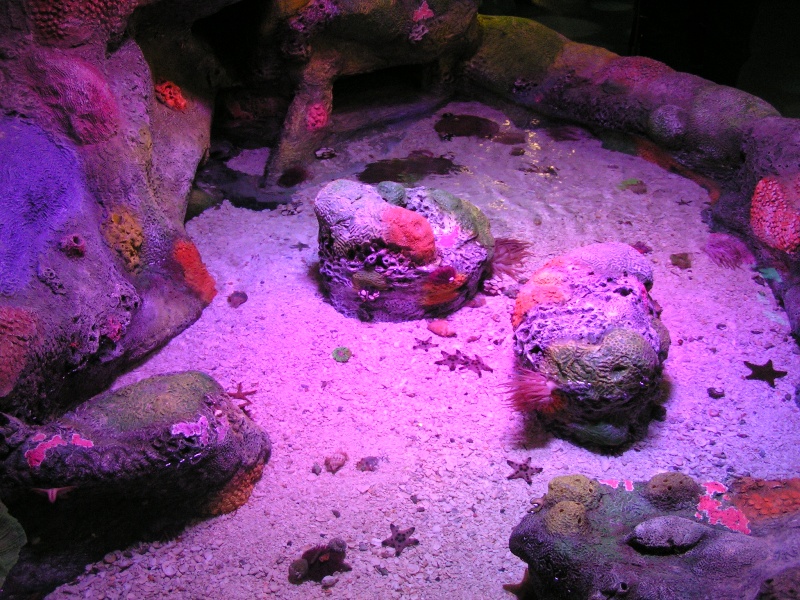
Sea Life Aquarium Grapevine, Texas


One day I was happily thumbing through one of our Texas travel magazines and saw that a new aquarium was opening up in nearby Grapevine, Texas. The new Sea Life Aquarium is located in, of all places the Grapevine Shopping Mall. I have no real problem with it being at a mall, except this same mall has a Legoland Discovery Center and an AMC theatre right across from each other. When we got there at 3 p.m., the parking lot for the entire mall was full which required us to join the other cars stalking a spot. Dianna’s eagle eye caught an escaping SUV pulling out on only our second turn around the northeast lot by the Aquarium. I might add, this was day 29 of the 100+ temperature days in the Metroplex and everybody without an air conditioner (and maybe those who did) was at the mall.
When I first researched the aquarium, I noted you could buy tickets cheaper online. Kids under two are free, kids 3-12 are $12.75 and 13+ were $16.15. At the door, kids are $15 dollars and 13+ are $19. Point is, you save on cash and the wait. Online tickets basically walk-in. Those waiting to buy at the door wait in a swirling line of overheated parents and screaming kids for HOURS. If you want to maintain your sanity, get the online tickets. I’m not sure about weekdays, we were there on a Saturday and the online tickets go fast. Book several days in advance. I was able to pick my time to enter three days before.

But, we are aquarium snobs. We come from San Diego, home of Sea World (long before San Antonio got theirs) and the Birch Aquarium at Scripps and the on Cannery Row Monterey Aquarium. We’ve seen some aquariums. Dianna loves looking at the fish and sea life. It brings back memories of home.

But let’s be fair. Sea Life is a multi-national company, which has aquariums all over the world and just recently came to America. Clearly, they are trying to get to the masses by choosing to open small aquariums in places like malls to get their message to about conservation and protecting the world’s oceans. I’m OK with that.
Sea Life has put together a diverse bunch of commonly identifiable fish and crustaceans that attracts and holds the attention of their demographic. Little people between say 3 to 12 years of age. Lots of bright and colorful displays and lots of little cute fish. And some sharks to get the “Shark Week” bunch to come in. I went to see their much-touted “360° Ocean Tunnel”. The tunnel is a walk-through lane with an arching acrylic glass at the bottom of their largest tank with sharks and fish continuously wandering by.


Throughout the aquarium, you pass through all your different food groups, Turtles, Rays, Sea Horses, Crabs, Eels and Octopus. So you have your Reef Sharks, Cownosed Stingrays, Common Octopus (are there any uncommon Octopi?), Jellyfish, Bonnethead Shark, Zebra Shark, Bowmouth Guitar Fish, Ribbon Sea Dragons, Big bellied Seahorse (so he has a weight problem, isn’t it cruel to label them like that?), Moray Eel, Nemo (Clownfish), Lionfish, and Starfish. The Shark Walk takes you to a room with a glass floor so you can stand over the shark tank as they glide silently under you like a 007 movie.


Oh yeah, I would have better pictures but you can’t use a flash or you become lunch in the Shark exhibit. But check out the website….I’m guessing the shots they got were with a flash.


What is cool is that they’ve done a pretty good job of making it kid friendly. Most of the exhibits are at eye level for little people and don’t require parents having to hold the kids up to windows, or what have you. There are exhibits where the little guys can crawl into the bottom of a tank and look from the inside like a deep-sea diver to watch the fish. There’s supervised “tidal pools” where they can touch or pick up a sea urchin. There’s always a kid activity in the area like one of those climbing play places like McDonalds to burn off some energy. At the end is a video where Sea Life Inc. tells their story of saving turtles, breeding programs and beach clean ups and how you can get involved at the local level.

Dianna contemplating the Rays

All in all a really worthwhile field trip if you don’t mind the crowds. The wife and I agreed that it was so crowded, you really couldn’t spend a lot of time at each exhibit or languish in the tunnel to wait for your favorite fish to go by. There was a kind of “keep up with the flow” sense of movement because of the crowding that took place whenever there was a bottleneck or stoppage. Probably better during a slow time or coming during the week could have avoided this. I wouldn’t mind going again at a more serene time.

Friday, July 29, 2011

Rangers Baseball


As many of you may know, I am not a sports guy. Occasionally I follow a hot football playoff series, Super bowl, Pennant race or Series but I’m not a dedicated fan. I don’t live for seeing a certain team in the lead or get in heated conversations about who has the best talent or struggle under the delusion that my life revolves around the machinations of a bunch of overpaid jocks who’s main talent is the throwing, hitting, catching of an object covered in leather or running into each other in the hopes of disabling the other human being.

OK, my real problem with viewing professional sports stems from a distinct dislike, almost abhorrence to standing in line for anything. I refuse to wait in a parking lot queue and hunting for that elusive parking space which doesn’t require hiking shoes and a canteen to get to the stadium. Or a drive-thru line or waiting outside of a restaurant holding that ridiculous vibrating and/or talking plastic disk annoyingly announcing, “Your table is now available.” I have poured over the lengths of checkout lines to gage how much sooner I could get checked out. Usually resulting in getting behind the lady with all the coupons and sadly watching the other customers I thought I was going to beat, leave before me. OK, I’m a convenience snob.

I have attended a game or two in my past. Usually with a diehard sports fan who can quote me statistics and can answer the Diamond Vision trivia question of who won the Heisman trophy for 1989. This has usually involved a free ticket because they couldn’t convince anyone else to go with them. This too is the result of a deep-seated trauma of always being the last guy picked for the team. I know I’m not the preferred choice, just the last one.

That said, my family is well aware of my quirkiness in this area and we have dodged this bullet on several occasions. Once in awhile, someone has a senior moment and they ask me along to a game. In this instance, my daughter was asked by her boss, Tracie, to accompany her and her betrothed, Barry, to a Rangers Game. Tracie has season tickets and asked Nicole along. OK, the free ticket requirement has been met and, although she is my daughter, I’m still wondering if she didn’t pick me because all her other friends weren’t available. Old feelings die-hard.
Fan adding to the ambiance

There is another wrinkle I forgot to mention. This is a really nice, modern, outdoor stadium. No covered or rollback roofs. Nope, this baby is an open-air stadium. Let me remind my audience, this stadium is in  Arlington, Texas in the middle of what could be another record year for days with temperatures exceeding 100 degrees.

When Nicole approached me about this about two weeks earlier, I noted the weather trend was warming and the forecast was triple digit. I broached the subject over a dinner we were having and I was assured the seats were under an upper deck and we would experience cool gentle breezes wafting from the facilities overhead fans.  After all, it was a “night game” and wouldn’t start until 7 in the evening. We would be kicking back in our seats and even be able to enjoy an ice cream in a cup in the shape of a batter’s helmet. In the days before the game, I was conjuring up visions of foot long hotdogs, fries and a refreshing ice filled drink enjoying one of America’s favorite pastimes.

Let me set the stage. On the appointed Sunday, the temperature at 7 p.m. was 101 degrees with about 45% humidity. Built in 1994 and costing about $191 million, Texas Rangers Stadium (formerly Ameriquest Field) is a 270 acre facility that took two years to build and can hold about 49,000 people. Attendance that night was about 23,000. We had really great seats on the 13th row up from the right center field wall, well under the upper deck and far away from any railings.

That was Dianna’s requirement since the second fall of a spectator  while trying to retrieve a ball thrown up to him by Josh Hamilton, a player for the Rangers. Yeah, like I was going to be reaching out into space to snag the winning run or something. It would most likely glance off my hand and wind up in the capable hands of some smug Little Leaguer who would then scoff at my feeble attempt. He might even add insult to injury by feeling sorry for me and handing it back just in time for the JumboTron to catch the moment for all to see.

 
But I digress. Here, seated in the place where the Giants took the trophy to the city by the Bay for their first time, in 2010. Tim Lincecum was wicked on the mound, Edgar Renteria broke a scoreless duel with a three-run homer in the seventh inning and San Francisco beat the Texas Rangers 3-1 in a tense Game 5 on a much cooler Monday night last October. Well, I got hungry.

The Rangers fare is typical of the 21st century baseball stadium. Hotdogs, hamburgers, fries, soft drinks and beer, lots of beer, interspersed with tall and cold gaily-colored Margaritas. Then there are the “other” food choices. Like Nolan Ryan beef sausage, Texas steak sandwiches, Blue Bell ice cream and pretzels large enough to feed four people. Fans can order gourmet dishes like a watermelon, feta and arugula salad (Really?) or a slider with oven-roasted veggies, tomatoes and Boursin cheese spread. The menu read like something you’d see on the Food Channel. I’m sure all of this has the American Heart Association’s stamp of approval.

There’s even a specially designed beer dispensing system that fills specially designed cups with beer though a hole in the bottom. This way, vendors won't have to pour the beer by hand (God forbid!), which can cause spills or foaming. The hole is kept closed by a flat magnet, and the cups are recyclable. How cool is that?

I am a bit of a traditionalist so Nicole and I started off with a good old hot dog (She bought). A nice foot long version, not overdone and very tasty. And why can’t anybody come up with a hot dog bun that has a hinged side that holds together once it’s accepted the dog. Although I have to admit, once I doused the dog with a layer of onions and relish, I may have exceeded the performance envelope of the bread. Still, can’t somebody do something about that? We can send men to the Moon but…..

While waiting for our dogs, I couldn’t help noticing the folks walking by with heaping boxes of these huge sweet potato fries. The term “fries” is not descriptive enough. We’re talking beautiful orange potato “wedges”. Think miniature churros. After downing my dog, I ran back and ordered up a batch of sweet potato fries. Herein lies the problem (refer to paragraph two). I had to wait in line, a long line. And then I discovered they didn’t have any sizzling away in anticipation of orders but tossed in one order at a time into the fryer.

Though noble in practice (nobody likes oily, overcooked fries), when you’ve got a line of hungry fans making multiple orders of fries, it got pretty confusing pretty quickly. Mind you, they made regular fries, garlic/cheese fries and sweet potato fries and only had two fry baskets to work with. Only two. I don’t believe a true production study (“A continuous study of relatively lengthy duration often made with the object of checking an existing or proposed standard time or its constituent parts, or obtaining information concerning the rate of output”) was ever conducted by this vendor. Literally, the cashier took an order, called it out to the fryers who took a handful of fries and tossed them into an empty fryer. It would take about five minutes to finish a batch, drain and pour the fries onto a plate and deliver them to the waiting customer. There was no accountability and the whole process really boiled down to the patrons keeping track of their own order. It was bedlam.

After being passed over once by a rather large, hungry (and scary) man who grabbed an order I was reaching for, it was survival of the fittest and I snatched the next batch out of the reach of a young Hispanic woman who, I noted, had not consulted the fashion police before she left the house in those ugly too-tall high heels and that slightly confining bright red tube top.

Coveting my prize like a five-point Buck over the hood of my pickup truck (hey, it’s Texas), I navigated my way back to our seats and Nicole and I shared a bonding moment dipping fry after fry in a vat of ketchup. It doesn’t get any better than that. Ok, it’s not your grandfather’s idea of a day at the baseball park, but it will have to do. In her later years, Nicole will be able to reflect on that moment and hopefully think fondly of her old man shoveling sweet potato fries into his pie hole and knocking back a large lemonade behind the right field wall. Truly, a Norman Rockwell moment.

We then stood for the Canadian and American National Anthems. Yeah, the Canadian National Anthem, “O Canada” the lyrics were originally in French in 1880 and translated into English in 1906 (they couldn't find anybody to do it sooner?).

O Canada!
Our home and native land!
True patriot love in all thy sons command.
With glowing hearts we see thee rise,
The True North strong and free!
From far and wide,
O Canada, we stand on guard for thee.
God keep our land glorious and free!
O Canada, we stand on guard for thee.

Brings a tear to the eye doesn’t it? Although, I must admit, the French version is much more moving. Then listened to the announcer read off the player rosters for the evening. It must have been the heat because the game kind of sputtered along all night. In the heat, Toronto seemed the most enthusiastic (go figure) while the Rangers just couldn’t get it together. It was scoreless until the sixth when Toronto brought in the only three runs of the game. Of course, whenever you broach the subject of a lackluster game, inevitably the response is, “Well, you should have been here last night.” Which, unfortunately, was true. The prior game with the Blue Jays was a heart stopper in which the Rangers were able to pull it out in the bottom of the ninth by scoring two runs, winning 5-4. It’s the luck of the draw.
Tracie and Nicole
As we approached the last inning, still 3 runs back, Nicole’s boss and benefactor Tracie, grabbed Barry’s baseball cap, turned it inside out and replaced the hat, bill looking up at an odd angle, back on his head. Tracie looked over at me and gave me the, “Well?” look through her beer goggles. I asked her why she had done what appeared to be a senseless act of meanness to her betrothed. Tracie said it was the “Rally Cap”. It seems, in Ranger Fan circles, when the team gets in trouble, you reverse your cap in some ancient Druid ritual to rally the team into performing. Tracie gestured that I do the same.
Note the dearth of "Rally Caps" in the crowd

Not wanting to shirk from a challenge to my manhood, and in the full view of my now cringing daughter, I reversed my hat and placed it on my head. Now, Barry had a canvas hat which, I believe, lends itself to reversal. I, on the other hand, had a more modern reinforced front panel and rigid material to my South Carolina Gamecocks (Go Fighting Cocks) cap. Let’s just say, it just didn’t look right. And as I surveyed my surroundings, I did not see another reversed hat in the lot. I think I was hood winked.

Nonetheless, our meager efforts were for naught as the end of the game did not bring victory. There was no joy in Arlington — the mighty Ranger has struck out.

As we joined the throngs of disappointed fans shuffling out to the street at 10 p.m., the temperature had cooled to a bone-chilling 98 degrees making the long walk back to our car further dampening our clothing and spirits. Once the air conditioner took hold, it was a relatively quick jaunt to the freeway and home. Certainly a night to remember and a great use of father/daughter quality time.  It’s been a while since my last Padre game at Petco. All kidding aside, there is always something magical about walking into that large stadium as one would enter a large cathedral, at once, awe inspiring and somehow comforting, stirring up old memories of similar times with friends and family. And let’s face it, because it’s America.

We’re baseball like Canada is hockey and Mexico is soccer. It’s in our DNA and helps us define ourselves within a world of cultures that we can’t always grasp. Like baseball, we’re about fairness, rule of law and most of all, team spirit. It is about winning and losing but everybody gets to play, no matter who you are or where you come from. And I like it. Thank you Tracie and Barry for asking us along and thanks Nicole, for taking your old man to a game.